MM/DD/YYYY — EST 00:00:00
STATUS: ACCEPTING NEW PROJECTS
kevin.russell@russellcontrols.com
Russell Controls — Engineering Consulting Firm
Home / About

Controls Experience With Complex Systems

Russell Controls LLC is owned and led by Kevin Russell, a multidisciplinary engineer with expertise in electrical controls, data acquisition, industrial equipment, and software development.

The owner has an educational background in Marine & Software Engineering with ten years in the electrical-controls field.
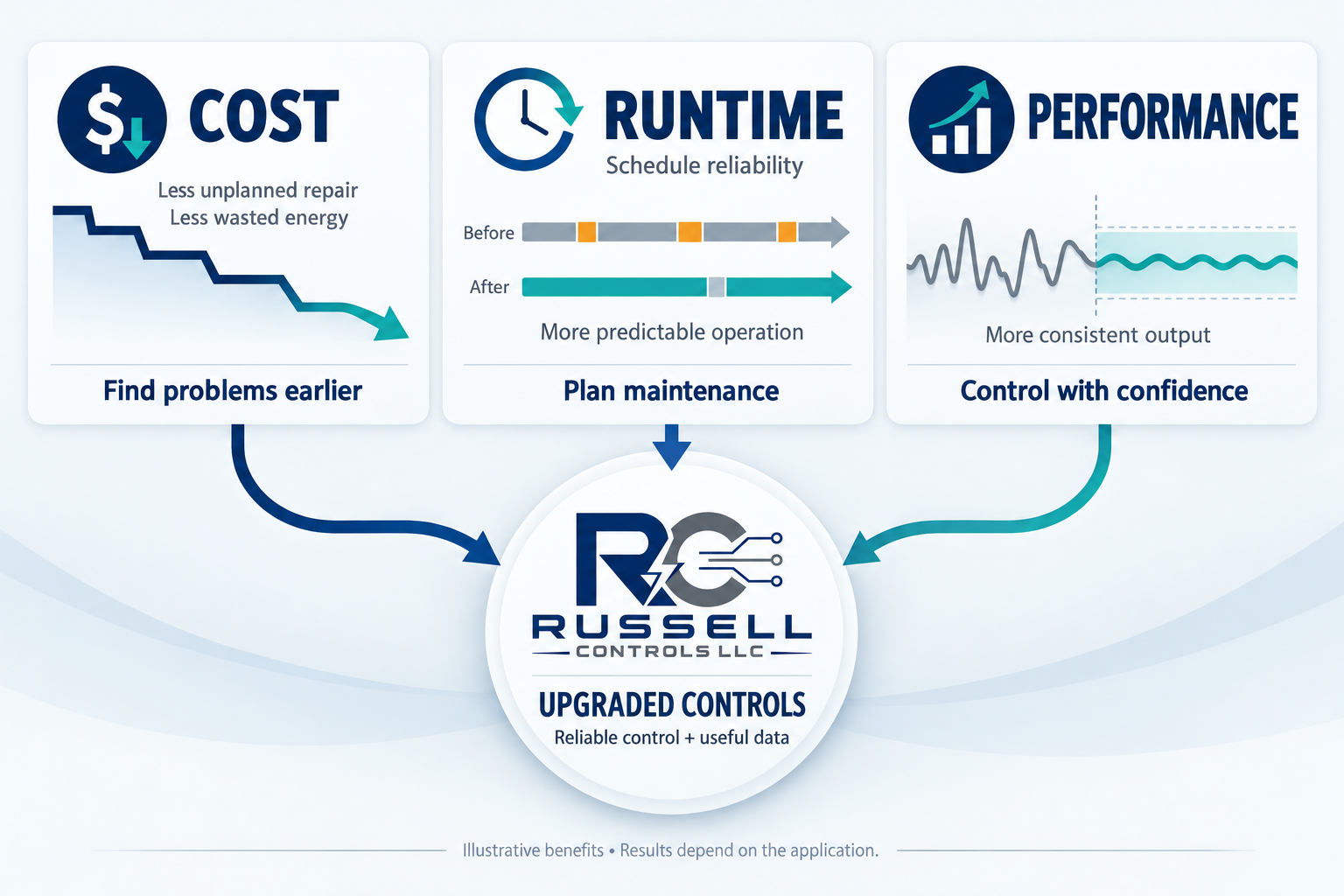
Diagram — upgraded controls lower cost, improve runtime, and steady performance
Fig. 01 — What an upgrade changesCost · Runtime · Performance

Three threads run through the principal engineer’s career — engineering, technician, and operator work. Together the experience shapes how Russell Controls scopes, builds, and commissions a system.

Engineering experience

Defense & Critical-Facility Controls

Electrical controls and data-acquisition engineer at a defense research laboratory — lead engineer for new and upgraded control systems on high-voltage transmitters, antenna motion, and industrial cooling.

Systems

Redundant 2 MW transmitters · 50 kW transmitter cooling · 1 kW transmitter · antenna control · +130 kV high-voltage controls · legacy PLC migrations to CompactLogix / ControlLogix · Allen-Bradley, Beckhoff, and Schneider PLCs · InfluxDB, OPC UA, and Grafana historian

Responsibilities
  • Controls programming in structured text, function block, and ladder — I/O configuration and scaling, PID and ramp/soak loops, Modbus to third-party devices.
  • Control-cabinet and remote-chassis design in AutoCAD Electrical, 480 V three-phase to 24 V DC: circuit protection, power distribution, sensor selection.
  • Created the site’s first time-series historian with secure remote monitoring.
Technician experience

Medical Robotics

Controls and instrumentation technician on automated assembly lines for a medical-device manufacturer — installation, start-up, qualification, and debug of new automation.

Systems

Allen-Bradley PLCs with FactoryTalk HMIs · ABB six-axis, parallel, and SCARA robots · Cognex and Keyence vision inspection · encoder-driven conveyors · VFD and servo drives

Responsibilities
  • Hands-on installation, start-up, qualification, and debug of new automation cells.
  • Field wiring, connectors, soldering, and device calibration with records.
  • Sensor troubleshooting and replacement; drive setup and tuning.
  • Corrective, emergency, and preventive maintenance logged as work orders, to NFPA 79 and NFPA 70E practice.
Operator experience

Utilities Operations

Recovery boiler and lime kiln operator at a kraft pulp mill — ran the units from the DCS, answered the alarms, and kept the shift record.

Systems

Honeywell Experion LX DCS · OSIsoft PI historian · recovery boiler and lime kiln · transmitters, variable-speed drives, actuators, limit switches, level indicators, and silica analyzers at 120–480 V

Responsibilities
  • Unit operation from the DCS; alarm response; readings logged every two hours; shift turnover.
  • Liquor and water chemistry — settling, silica, pH, TTA, density, percent solids.
  • Work orders for maintenance and upgrades; one-line drawing redlines; plant maintenance carried out on shift.
  • TAPPI Kraft Recovery Short Course — calcination, slaking, and recovery chemistry.
Earlier engineering roles

Fuel-equipment design engineer converting high-pressure utility boilers from coal to natural gas — fan, valve, and piping sizing, and site commissioning for efficiency and NOx. Process control engineer on environmental test systems — ladder logic, Modbus and serial communications, SCADA data recording, and controller documentation.
Owner Profile
Name
Kevin Russell — Principal Engineer & Owner, Russell Controls LLC
Education
B.S. Marine Engineering Technology, Maine Maritime Academy · B.S. Computer Science, Southern New Hampshire University
Experience
Ten years in electrical controls and data acquisition, across industrial, utility, marine, and defense systems.
Qualifications Summary
Business
Russell Controls LLC — Massachusetts · Est. 2026
Federal
SAM.gov registration — pending
Clearance
DoD Secret security clearance (personal)
Maritime
TWIC — expired 2022 · renewal available
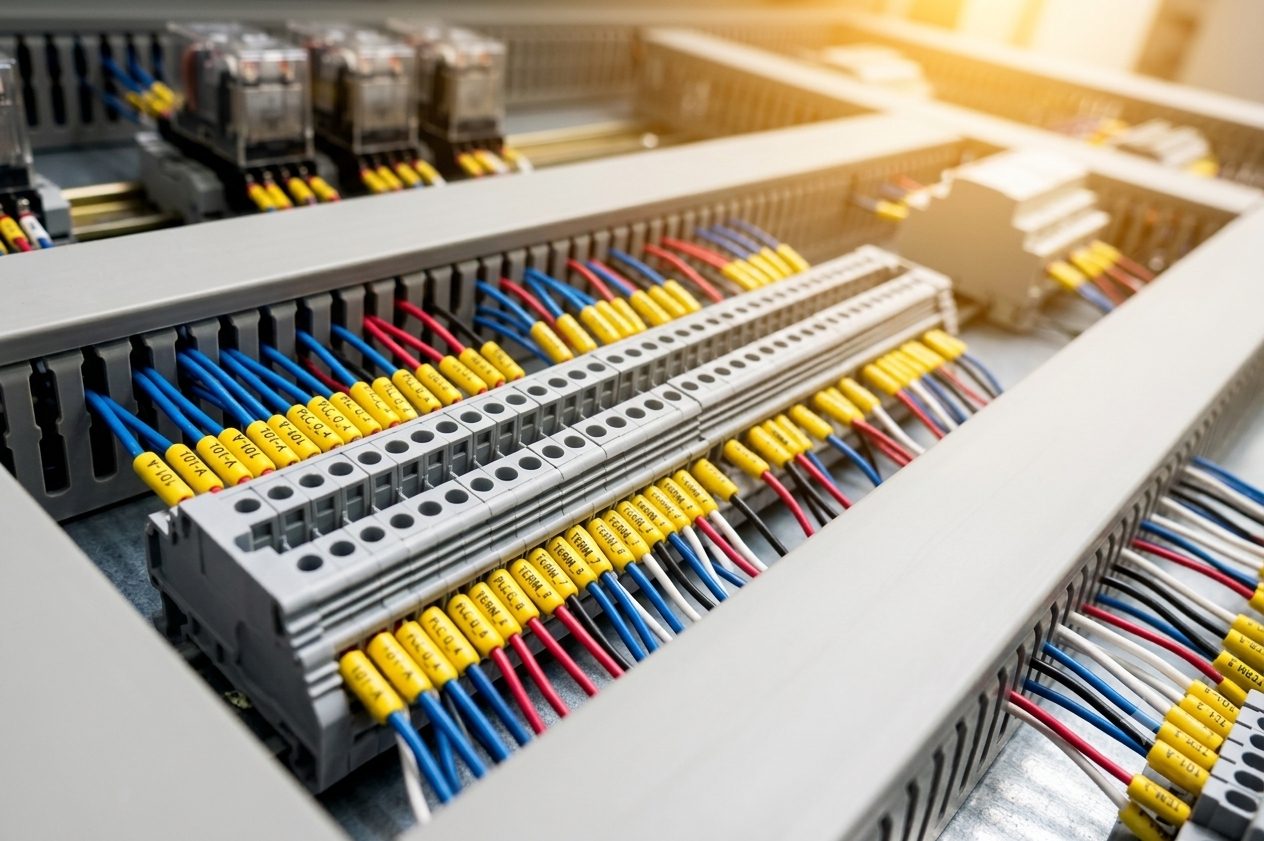
Close-up of professionally wired terminal blocks
Sensor to dashboard · Drawing to commissioning · Data to decision

Build it clean, prove it works, and leave a record the site can trust.

Step 01

Understand

Review drawings, P&IDs, field wiring, equipment behavior, alarms, and operator needs before recommending hardware or software.

Step 02

Design

Translate the real process into panel layouts, I/O plans, network structure, control narratives, HMI screens, and data tags.

Step 03

Commission

Verify field equipment, electrical connections, process control, HMI operation, and the historian on site — against acceptance criteria agreed up front.

How the outage is run ↓
Step 04

Hand Over

Editable drawings, PLC/HMI source and backups, operator training, and maintenance notes — so your operators and maintenance staff can own the system.

The greatest risk in a controls upgrade is concentrated within the shutdown window. Russell Controls reduces that risk by completing design, programming, testing, documentation, and readiness checks before the outage begins. Commissioning and handover then follow a defined cutover plan with clear decision points, rollback criteria, acceptance testing, and an agreed return-to-service milestone.

Phase 01

Before the outage

  • Panel factory-tested; software bench-tested against simulated I/O.
  • Field-wiring drawings issued to the electrical contractor; mechanical, piping, and OEM dependencies listed with owners and dates.
  • Anticipated downtime listed by activity — demolition, panel set, terminations, checkout, restart.
  • Readiness check one to two weeks ahead: parts on site, trades confirmed, access and permits in hand.
  • Contingency plan agreed: rollback to the legacy controller, spares on hand, and the triggers that would extend or abort the window.
Phase 02

Inside the window

  • Cut-over in the agreed sequence, with a daily check of progress against the plan.
  • I/O verified point by point from the field device to the HMI.
  • Integrated functional testing: each sequence, alarms, interlocks, redundancy, and forced failure responses.
  • Go / no-go decisions against the contingency triggers — never a late surprise.
Phase 03

Restart & handover

  • Restart criteria signed off: equipment proven in automatic, alarms verified, operators briefed.
  • Live sequence testing, loop tuning, and lead/lag checks at operating load.
  • Punch list with owners and dates; acceptance signed.
  • Handover documentation and operator training — what is handed over ↑

Testing & Acceptance

Acceptance criteria for both tests are agreed at the end of the assessment, before the build is priced. The two tests answer different questions.

FAT · in the shop

Factory Acceptance Test — the panel

Answers: is the panel built as drawn?

Point-to-point wiring verification against the drawings, device power-up with firmware loaded, I/O forced at the terminals, and a power-quality and load check. Witnessed by the customer on request; test record delivered with the panel.

SAT · on site

Site Acceptance Test — the integrated system

Answers: does the system behave as specified with real equipment?

I/O verified end to end to field devices; each sequence exercised; alarms and interlocks proven; redundancy and failure responses forced — loss of running equipment, loss of signal, loss of power or communication; operator walkthrough of the HMI. Signed by both parties.